
Last updated November 25, 2026
 Wrought iron
 Wood & steel frame
 Farm & ranch
 Sliding driveway gates
 LiftMaster operators
Free on-site gate assessment - hinges, posts, and your LiftMaster or Nice gate operator checked before anything is quoted
The assessment is free and the quote is the invoice.
Get your free estimateGate Repair Permits, Codes & Inspections in Knoxville, TN: What You Need to Know
Here’s the part most people get wrong: repairing a gate is usually not permitted work, but automating one almost always is. The moment a technician bolts an operator onto a manual gate and runs power to it, the job stops being gate repair and becomes an electrical installation, and electrical installations in Knox County go through the permitting process. Plenty of contractors skip that step because it’s paperwork they’d rather avoid. The homeowner finds out years later, often during a sale, when an inspector asks for documentation that doesn’t exist. This guide covers the split between repair and permit-triggering work, how the NEC applies to operator wiring, what inspectors actually look at, HOA overlays that stack on top of city code, and how to permit an existing automated gate after the fact. If you’re in Knoxville and weighing any of this, the sections below are written for you.
Quick Answer
In Knoxville and the surrounding county, like-for-like gate repair (replacing a hinge, a latch, a roller, a damaged panel, or swapping an operator with a similar unit on existing wiring) generally does not require a new permit, while any new electrical circuit run to a gate operator, and usually a new automated gate installation as a whole, does require a permit and an electrical inspection. Electrical work must follow the National Electrical Code, which governs the operator’s power circuit, disconnect, and grounding. HOA architectural rules in many Knoxville-area developments add their own gate specs on top of city and county code, so approval can be a two-stage process. Always confirm specifics with the City of Knoxville’s permits office or Knox County Codes before work begins, since requirements can vary by property and scope.
Styles & brands we work with
- Wrought iron
- Wood & steel frame
- Farm & ranch
- Sliding driveway gates
- LiftMaster operators
Table of Contents
- What Gate Work Requires a Permit in Knoxville?
- How Does the NEC Apply to Gate Operator Wiring?
- What a Compliant Gate Installation Looks Like vs. a Shortcut
- HOA Overlay Rules in Knoxville-Area Developments
- The Inspection Process: Who Inspects and What They Check
- How to Retroactively Permit an Existing Automated Gate
- Common Mistakes to Avoid
- When to Call a Professional
What Gate Work Requires a Permit in Knoxville?
The dividing line is simpler than most people expect: does the work create a new electrical circuit, or does it repair what’s already there? That single question decides most permitting outcomes in Knoxville. A gate that stops latching because a hinge is bent is a mechanical repair. A gate that now swings open on its own because someone added a motor and a keypad is a small electrical project with a building-code footprint.
Here’s the general breakdown. Treat it as orientation, not a ruling on your specific property, and confirm with the city or county before scheduling.
Usually no permit required:
- Replacing hinges, latches, rollers, stops, or guide hardware on a manual or automated gate
- Straightening or re-hanging a sagging gate leaf
- Replacing a damaged picket, panel, or section
- Repairing or adjusting an existing operator on its existing power supply
- Swapping an operator for a comparable unit wired to the same circuit
- Replacing a remote, receiver, or keypad on existing wiring
Usually requires a permit:
- Adding an automatic operator to a gate that was previously manual (this is new electrical work)
- Running a new power circuit from the house, panel, or meter to the gate location
- Installing a new automated gate where none existed
- Upgrading electrical service at the gate beyond the existing circuit
- Adding access-control equipment that requires new dedicated power
- Installing a new gate structure that meets the definition of a fence or wall improvement under local rules
The automation case is the one people miss. A homeowner with a manual driveway gate calls about a motor, reasoning that “the gate already exists, the motor is just an accessory.” That’s not how the code frames it. The existing gate was never an electrical device. Once it is, the installation is subject to electrical permit requirements, exactly the way a new outdoor outlet or a hot tub would be. Existing manual gate repair in Knoxville is a hardware job. Automating that same gate is an electrical installation.
If you’re planning a gate installation that includes automation, ask whoever quotes the work whether the price includes the permit. A quote that doesn’t mention it usually doesn’t cover it.
How Does the NEC Apply to Gate Operator Wiring?
Gate operator wiring is not exempt from the National Electrical Code just because it lives outdoors at the end of a driveway. The NEC treats a gate operator as electrical equipment, and the install has to meet the same baseline you’d expect for any outdoor circuit: proper conductor sizing, a compliant raceway or direct-burial method, correct disconnect means, and grounding.
What that means in practice for a Knoxville property:
- Power source and circuit protection. The operator needs a dedicated circuit from a panel, with a breaker sized to the operator’s nameplate requirements. Tapping into an existing lighting circuit at the front of the house is a shortcut that inspectors catch immediately.
- Wiring method. The run from the building to the gate must use a compliant method for outdoor use and burial depth. Direct-bury cable rated for the application, or conduit, depending on how it’s routed. A loose cable laid in the dirt fails.
- Disconnect. There must be a way to de-energize the operator for service. Where that disconnect sits and how it’s labeled matters to the inspector.
- Grounding and bonding. The equipment grounding conductor has to be continuous and properly bonded to the operator and any metal parts it energizes, including the gate frame in some configurations.
- Low-voltage controls. Access control, safety edge, and loop wiring run at low voltage, but the way that wiring enters the operator and is protected from moisture and physical damage still counts.
- Outdoor rated components. Every box, fitting, and enclosure has to be rated for wet location. Indoor-rated boxes on a gate post in a Knoxville summer storm are a common failure.
The safety conversation matters here. Operator wiring carries line voltage at a location people stand next to, in wet conditions, with a heavy moving object overhead. A gate operator isn’t a light fixture. If a motor has power at the terminal strip and you’re not familiar with lockout and meter work, that’s a call-a-technician moment. We tell people plainly: don’t poke around inside the operator housing.
When the electrical side is done properly, everything downstream, from operator service to keypads, works from a stable foundation. Our gate motor & opener work includes the electrical side of the install, which is exactly why the permit question comes up in conversation before we quote. Brands like LiftMaster, FAAC, and BFT all specify their own power requirements, and the label on the unit is what the wiring has to answer to.
What a Compliant Gate Installation Looks Like vs. a Shortcut
Most unpermitted gate work isn’t malicious. It’s the difference between a tech who knows the code and one who installs to habit. The shortcuts look fine at the gate and fail weeks, months, or a sale later. Here’s the contrast, side by side.
What a compliant installation looks like:
- Voltage drop is calculated for the actual run distance before wire is pulled. Long driveway runs at 12V or 24V operators are where undersized wire shows up as a slow or stuttering gate.
- The power run is sized, protected, and buried to the depth and method the wiring type requires, in conduit or rated cable.
- A labeled disconnect is available within the equipment area for servicing the operator.
- Every outdoor enclosure, splice, and fitting is wet-location rated and properly sealed against Knoxville’s summer thunderstorms.
- Safety devices are installed and functional: photo eyes, safety edges, and reversing features that protect people and pets in the gate path.
- Grounding is continuous and bonded to the operator and any metal gate components it touches.
- The permit is pulled before work, and the electrical inspection is scheduled as part of the job.
What a shortcut looks like:
- Wire undersized for the run, causing the operator to work hard in hot weather.
- A power run draped along the fence line, stapled to a post, or buried shallow without protection.
- No disconnect. Servicing requires killing the whole house circuit.
- Indoor junction boxes screwed to a gate post.
- Safety eyes installed but defeated because they were “getting tripped by the weather.”
- No permit, no inspection, no documentation for the next owner of the house.
If you’re not sure which list your existing gate falls on, the honest test is whether there’s a sticker on the panel cover or a record in the county system. Nobody remembers the paperwork from a decade ago. A gate-system specialist can trace the wiring back to the panel and tell you what’s there. Our team handles gate repair across all of these systems, and figuring out whether the last install was done right is part of the job far more often than customers expect.
HOA Overlay Rules in Knoxville-Area Developments
The city permit is only half the story. Many Knoxville-area neighborhoods are covered by an HOA or architectural review committee that has its own opinion about gates, and that opinion can be stricter than anything the city requires. A gate that passes inspection can still get a letter from the association.
What HOA overlays typically cover:
- Gate material and finish. Some communities restrict you to a specific metal finish, wood type, or paint color.
- Height and style. Even where the city allows a range, the HOA may lock in a single design to keep the streetscape consistent.
- Automation visibility. Some associations care about whether the operator and hardware are visible from the street, which sometimes pushes the install toward a specific brand or slim-profile model.
- Access control compatibility. Communities with a shared entrance or gate may require that any resident-added device not interfere with the association’s own access system, keypads, or loop detection.
- Signage and call boxes. Where the keypad, intercom, or directory sits, and how it looks, is often dictated.
The practical answer for anyone automating a gate in a Knoxville HOA: get the architectural approval in writing before the install, keep it with the permit paperwork, and give your gate technician a copy. If the HOA specifies a brand or model because it has to integrate with an existing community system, that detail belongs in the conversation before anything gets ordered, not after. DoorKing and Linear both turn up in shared-access scenarios where the association controls the system, and mixed equipment sometimes means a receiver or controller has to be matched to the association’s side. Checking that up front saves a lot of finger-pointing.
If you’re not sure whether your property has an HOA overlay, the county property record and your closing packet are the first places to look.
The Inspection Process: Who Inspects and What They Check
Once a permit is pulled, an electrical inspection follows. In the Knoxville area, inspections are handled by the local authority with jurisdiction over the permit, typically the city or county electrical inspection department. Your electrical contractor or the gate company handling the install schedules the inspection when the work reaches the point where it can be looked at.
What inspectors typically look at:
- The permit is on site and matches the scope of work.
- The power source: which panel and which breaker, and whether the circuit is dedicated and correctly sized.
- The wiring method from the building to the operator: type of cable or conduit, burial method, and protection.
- The disconnect at the operator and its labeling.
- Grounding and bonding continuity.
- Wet-location ratings on boxes, fittings, and enclosures.
- Any additional requirements under local amendments to the code.
Timeline. It depends on scheduling at the inspection office and how close the work is to completion. The electrical rough-in usually has to be inspected before burial or concealment, and a final inspection happens when the install is complete. In practice, gate installs in Knoxville often go through a rough inspection (wire in place, before covering) and a final (operator up, safety devices in, disconnect labeled). If the inspector finds an issue, it gets corrected and re-inspected, which is why the corrections in a first pass can add time to the project. It’s also why we build inspection time into the schedule instead of treating it as an afterthought.
One point worth saying out loud: the inspection protects the homeowner, not the contractor. A passed inspection is documented proof that the work was done to standard, which is the piece you want in your file when you sell the property or make an insurance claim after a storm.
How to Retroactively Permit an Existing Automated Gate
Maybe a previous contractor skipped the permit. Maybe the gate came with the house and there’s no record of anything. Either way, unpermitted automation is fixable. It just takes a process, and the process starts with finding out what’s actually there.
Steps to retroactively permit an automated gate in Knoxville:
- Get the county property record and search for permits. You want to know whether any gate or electrical permit exists on the property. If nothing shows up, assume there isn’t one.
- Have the install inspected by a gate-system specialist. The point is to document what’s currently installed: which operator, what brand (LiftMaster, FAAC, BFT, and similar are common), the power source, the wiring method, and whether the safety devices are present and functional. This inspection is not the code inspection. It’s the assessment that tells you what the code inspection is going to require.
- Correct the deficiencies. Undersized wire, missing disconnect, indoor-rated enclosures, defeated safety eyes, and buried cable without protection are the usual corrections. Sometimes it’s a hardware swap, sometimes a wiring run.
- Pull the permit. File for the electrical permit through the city or county that has jurisdiction, describe the existing installation accurately, and list the corrections you’re making.
- Schedule and pass the inspection. Same process as a new install. Rough and final, as required.
- Keep the documentation with the property records. The paperwork is the asset. It tells the next owner, the next inspector, and your insurer that the gate was brought up to standard.
We want to be honest about the cost picture. Fixing unpermitted work usually costs more than doing it right the first time, because you’re paying for the assessment, the corrections, and the permit process on work that already exists. Sometimes the wiring is fine and only the paperwork and the safety devices need attention. Sometimes the whole run needs to be redone. Either way, dealing with it on your own schedule is preferable to a surprise during a real estate transaction.
Common Mistakes to Avoid
- Assuming an existing gate means no permit. A manual gate that gets a motor is an electrical installation, no matter how long the gate has been there. The permit question turns on the wiring, not the age of the gate.
- Skipping the HOA before the install. Knoxville-area HOA architectural rules can override a city-approved gate design. Get written approval up front and keep it.
- Treating the permit as optional paperwork. The electrical inspection is the documentation that protects you at resale and in an insurance claim. Skipping it is a shortcut with a delayed cost.
- Letting the original installer handle the electrical side loosely. The power run from the panel to the gate is the part most likely to be undersized or improperly buried. It’s also the part most likely to fail an inspection.
- Defeating the safety eyes or safety edges because they “trip too easily.” Those devices are a code requirement and the difference between a gate that reverses and one that closes on someone. If they’re tripping, they’re out of alignment or dirty, not unnecessary.
- Mixing brands without checking compatibility. Putting a different operator on an existing access-control system (a LiftMaster receiver on a DoorKing-controlled system, for example) sometimes works and sometimes locks out the shared access. Verify before you buy.
- Losing the documentation. Permit record, inspection sign-off, product manuals, and HOA approval all belong in a single file with the property paperwork. It’s the first thing an inspector or buyer asks for.
When to Call a Professional
Some gate tasks are homeowner-friendly: cleaning a track, replacing a remote battery, wiping down a keypad. Others belong with a trained technician. Call a professional when the gate won’t move and the operator is showing a fault, when the power side needs to be touched at all, when a sliding gate has come off its track or a swing gate has shifted on its posts, when the safety devices aren’t working and you don’t know why, when you’re automating an existing manual gate and need the permit handled properly, when an existing automated gate has no permit record and you want it sorted out, or when a failing motor is producing symptoms a general repair service can’t diagnose. Motor, sensor, and control-board faults are exactly where a general handyman runs out of road and a gate specialist gets called in.
We’re the team behind Knoxville Gate Repair Co, and we offer free estimates in Knoxville. Call (877) 820-8549. We answer 24/7. Fast dispatch from 7am to 7pm, Sunday through Friday. Our technicians have up to 8 years of experience across residential and commercial gate systems, including LiftMaster, FAAC, BFT, Linear, Viking, Ghost Controls, DoorKing, Elite, and Mighty Mule. The price is quoted and agreed before any work starts, and the written estimate sets the final number.
See the difference
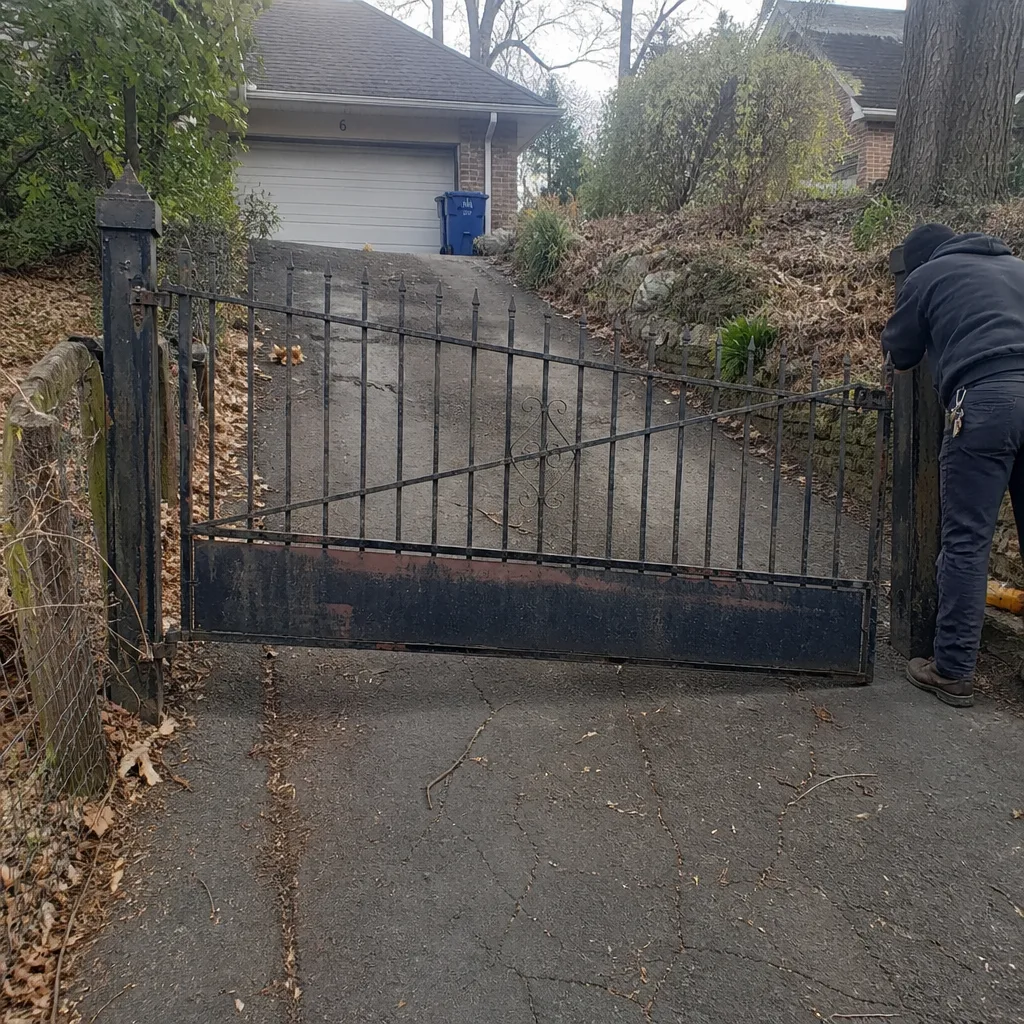 Before
 After
 Before
 After
 Before
 After
Frequently Asked Questions
Usually not. A like-for-like repair (hinges, latches, rollers, panels, or an operator serviced on its existing wiring) is generally exempt from permitting because no new electrical work is created. Automating a previously manual gate or running new power to the gate is different, and that work typically does require a permit. Confirm specifics with the City of Knoxville or Knox County Codes before scheduling, and call (877) 820-8549 if you want the scope evaluated first. Estimates are free.
Yes, in most cases. Adding an operator converts a manual gate into an electrical installation, which brings the work under electrical permit requirements even though the gate structure itself isn’t new. The permit covers the circuit that feeds the operator, the disconnect, and the grounding. Call (877) 820-8549 for a free estimate that includes the permit conversation up front.
The National Electrical Code (NEC), as adopted locally with any amendments, governs the electrical side of a gate operator: dedicated circuit, protective device sizing, wiring method, burial requirements, disconnect, and grounding. The operator manufacturer’s label sets the electrical requirements the install has to meet. If you’re not familiar with lockout and meter work, leave the inside of the operator housing to a technician. Call (877) 820-8549. We answer 24/7. Fast dispatch from 7am to 7pm, Sunday through Friday.
Typically the permit, the power source and breaker, the wiring method from building to operator, the disconnect and its labeling, grounding continuity, wet-location ratings on boxes and fittings, and any local amendments. The inspection usually has a rough stage (before burial or concealment) and a final stage when the install is complete. Call (877) 820-8549 for a free estimate that includes the inspection steps in the plan.
Look up the county property record and search the permit history for the address. If no electrical or gate permit appears, assume the work was done without one. From there, a gate-system specialist can assess the install, identify what a code inspection will require, and walk you through the retroactive permit process. Call (877) 820-8549 to schedule that assessment. Estimates are free.
Yes. HOA and architectural review rules can be stricter than city or county code on gate material, finish, height, style, and whether the operator is visible from the street. Get written HOA approval before you install or automate, and keep that approval with your permit documents. Call (877) 820-8549 if you need the technical side checked before the HOA review.
The Bottom Line
The permit question on a gate comes down to one thing: whether new electrical work is being created. Repair is a hardware job and generally doesn’t need a permit. Automation and any new power run to the gate do, and the electrical inspection that follows is the documentation that protects you at resale and after a storm. HOA overlays in Knoxville-area neighborhoods can add their own gate specs on top, so check both before work begins. If a previous contractor skipped the permit, the situation is fixable; it just takes an assessment, the right corrections, and a documented inspection. Get the paperwork right and the gate itself will keep working for years.
Not sure which side of the permit line your project falls on? Call (877) 820-8549 for a free estimate. We answer 24/7. Fast dispatch from 7am to 7pm, Sunday through Friday. The price is quoted and agreed before any work starts.
Written by the team at Knoxville Gate Repair Co.